

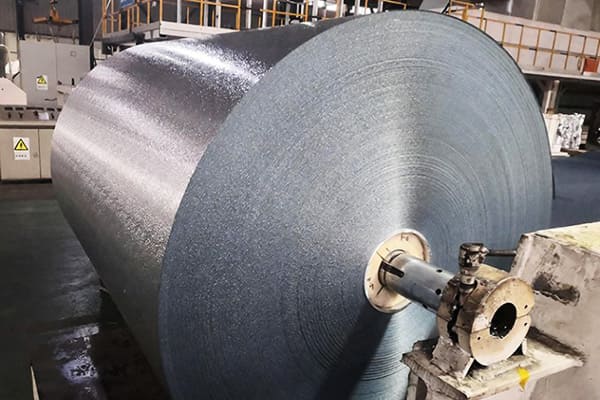
1. Introduction
1100 H22 coated embossed aluminum foil is a hybrid engineering material that combines a commercially-pure aluminum substrate (合金 1100) in a work-hardened/partially-annealed H22 temper with a patterned (浮雕的) surface and a functional coating.
This combination delivers an attractive package of properties: high thermal/electrical conductivity and corrosion resistance from the high-purity alloy; controlled strength, springback and dimensional stability from the H22 temper; increased out-of-plane stiffness, enhanced heat-transfer surface area and tactile benefits from embossing; and corrosion protection, printability or sealability from the applied coating.
Quantitatively, 1100 alloy contains ≈99.0–99.95% Al by weight; H22 temper raises yield and tensile properties relative to fully annealed stock (representative tensile ranges for H-tempers fall in the 80–120 MPa band depending on processing); and common heat-seal or protective coat weights for foil applications sit in the low grams-per-square-metre range (typical industry practice centers around ~5–7 g/m² for thin functional lacquers).

1100 H22塗層壓花鋁箔
2. Understanding 1100 H22塗層壓花鋁箔
To fully appreciate this specialized aluminum foil, it’s crucial to understand the individual contributions of its alloy, temper, coating, and embossing.
2.1 Chemical Composition of 1100 鋁合金
| Element | Content Range | Functional Role | Performance Impact |
| Aluminum (鋁) | ≥99.00 | Base matrix | 耐腐蝕, thermal conductivity (222 W/m·K), electrical conductivity (59% IACS) |
| Silicon (和) | ≤0.95 | Casting aid, trace strengthener | Improved fluidity during casting, minor solid solution strengthening |
| Iron (鐵) | ≤0.35 | Grain control | Forms intermetallic phases that control recrystallization behavior |
| Copper (銅) | 0.05–0.20 | Intentional strengthening element | 10–20% strength increase vs. 1050/1060 alloys, maintains conductivity |
| Manganese (錳) | ≤0.05 | Grain refiner | Texture control during thermomechanical processing |
| Zinc (鋅) | ≤0.10 | Impurity control | Minimizes galvanic corrosion potential |
| Others (each) | ≤0.05 | — | — |
| Others (total) | ≤0.15 | — | — |
Sources: ASTM B209, AA standards, 在 573-3
2.2 Understanding H22 Temper
Temper refers to the mechanical and thermal treatment history of an aluminum alloy, influencing its strength and ductility.
H22 temper signifies a strain-hardened (work-hardened) to quarter-hard temper, followed by a stabilizing anneal.
- Strain Hardening: The initial work hardening during rolling increases the material’s strength and reduces its ductility.
- Stabilizing Anneal: A controlled, partial annealing heat treatment is then applied. This stabilizes the mechanical properties and prevents natural aging effects.
- Balance of Properties: H22 temper provides a specific balance: it is stronger than fully annealed (‘O’ temper) 1100 but retains good formability and ductility. This controlled strength is ideal for applications where the foil needs to hold its shape better than soft foil but still allows for some bending or shaping.
2.3 The Role of Coating on Aluminum Foil
A coating is a functional layer applied to the aluminum foil surface to enhance specific properties beyond the base metal.
- Protection: Shields the aluminum from corrosion, chemical attack, or abrasion.
- Functionality: Provides heat-sealability to other materials, improves printability, or offers specific release properties.
- Aesthetics: Can impart color, gloss, or a matte finish, complementing the embossed texture.
- Adhesion: Acts as an adhesive primer for subsequent laminating or bonding.
2.4 Benefits of Embossing Aluminum Foil
Embossing is a mechanical process that creates a raised or sunken pattern on the foil’s surface. This seemingly simple step provides multiple critical benefits:
- Enhanced Aesthetic Appeal: Adds texture, visual depth, and a distinctive appearance (例如, stucco, diamond plate, pebble patterns), giving the foil a premium or industrial look.
- Improved Stiffness and Rigidity: The mechanical deformation during embossing structurally stiffens the foil, making it more resistant to buckling, creasing, and general deformation compared to plain foil of the same gauge.
- Reduced Sticking and Easier Separation: The raised pattern significantly reduces the contact area between stacked layers of foil. This prevents “blocking” (where layers stick together) and facilitates easier unwinding from rolls, especially for thicker gauges.
- Increased Surface Area: The textured surface increases the effective surface area of the foil, which can be beneficial for applications requiring enhanced heat transfer (dissipation or absorption) or improved adhesion for subsequent layers.

Huawei Embossed Aluminum Foil Display
Common Embossing Patterns
| Pattern Type | Description | Depth Range | Primary Applications |
| Stucco | Random granular texture resembling plaster | 0.05–0.15 mm | HVAC duct facing, general insulation |
| Orange Peel | Fine dimpled surface, uniform appearance | 0.03–0.08 mm | Architectural panels, aesthetic applications |
| Diamond/Ribbed | Geometric repeating pattern | 0.05–0.12 mm | Structural applications, directional stiffness |
| Custom | Client-specific logos, textures | Variable | Brand identification, specialized airflow |
3. Materials Science and Metallurgy of 1100 H22 Aluminum Alloy
3.1 Chemical composition
Commercial datasheets and standards specify 1100 as ≈99.0–99.95% aluminum with trace Cu (0.05–0.20%), Fe ≤0.95%, Si ≤0.95%, Mn ≤0.05% and small amounts of Zn and other residuals.
These strict impurity limits are central to 1100’s properties: low alloying preserves conductivity and corrosion resistance while allowing modest increases in strength from cold work.
3.2 Role of high purity
High Al content gives three practical advantages:
(1) excellent thermal conductivity (useful in heat-transfer or heat-spreading applications),
(2) superior electrical conductivity and EMI shielding when needed
(3) good natural corrosion resistance in many environments.
The downside is relatively low as-fabricated strength compared to intentionally alloyed series, which is why tempering (work hardening or partial anneal) is used to reach the required mechanical window.
3.3 The H22 temper microstructure
H22 is produced by working the material (冷軋) and then applying a partial anneal that allows some recovery and recrystallization.
The microstructure in H22 shows a mixed population of strain-hardened and recrystallized grains, producing elevated yield/tensile strength (compared to O) alongside measurable elongation and reduced brittleness.
Representative mechanical data for 1100 aluminum foil in H-range tempers show ultimate tensile strength often in the 80–120 MPa region and yield strength elevated accordingly, depending on exact processing and gauge.
These values must be confirmed with supplier Certificates of Analysis for design calculations.
4. Manufacturing Process of 1100 H22塗層壓花鋁箔
The creation of 1100 H22 coated embossed aluminum foil involves a sequence of highly controlled metallurgical and surface treatment processes.

1100 H22 Coated Embossed Aluminum Foil Production
4.1 Melting and Casting
- High Purity Melting: High-purity aluminum ingots and minimal alloying elements (like copper) are melted in controlled furnaces.
- Continuous Casting: The molten aluminum is typically cast into large, continuous slabs or ingots, ensuring a uniform and refined microstructure suitable for subsequent rolling.
4.2 Rolling Process
- Hot Rolling: Cast slabs are hot-rolled at elevated temperatures to reduce their thickness and refine the grain structure, preparing the material for cold working.
- Cold Rolling: The material then undergoes numerous passes through high-precision cold rolling mills. This stage gradually reduces the thickness to the desired foil gauge (例如, 0.05 mm to 0.20 毫米), simultaneously inducing work hardening.
4.3 Tempering (H22)
Controlled Partial Anneal: After cold rolling to a specific work-hardened state, the foil undergoes a precise partial annealing heat treatment.
This critical step sets the H22 temper, providing the required quarter-hard strength and stabilized properties.
The temperature and duration are meticulously controlled to achieve the desired balance between strength and ductility.
4.4 Embossing
- Pattern Transfer: The H22 tempered foil is fed between two specialized rollers. One roller has the desired male (raised) embossing pattern (例如, stucco, pebble), and the other is either a matching female die roller or a resilient backing roller.
- Mechanical Deformation: Under controlled pressure, the pattern is mechanically pressed and deformed onto the foil surface.
- Pattern Consistency: The process parameters (pressure, speed, temperature) are finely tuned to ensure a consistent pattern depth and uniform texture across the entire foil surface without compromising its integrity.
4.5 Coating Application
- Pre-Treatment: Before coating, the embossed foil’s surface is thoroughly cleaned and often pre-treated (例如, corona discharge) to enhance surface energy and ensure optimal adhesion of the coating.
- Coating Method: Depending on the coating type and viscosity, techniques like gravure, flexographic, or precision roll coating are used to apply a uniform layer of lacquer, polymer, or primer onto the embossed surface.
- Drying/Curing: The coated foil then passes through drying ovens, where solvents evaporate and, for polymer coatings, cross-linking occurs to create a durable, cured film.
4.6 Quality Control
Throughout the entire process, stringent quality control measures are implemented:
- Material Composition: Verification of 1100 alloy purity.
- Dimensional Accuracy: Precise measurement of foil thickness, width, and gauge uniformity.
- Mechanical Properties: Testing for tensile strength, yield strength, and elongation to confirm H22 temper.
- Pinhole Count: Inspection for pinholes, critical for barrier applications.
- Embossing Quality: Assessment of pattern depth, uniformity, consistency, and freedom from defects.
- Coating Quality: Measurement of coating thickness (g/m²), adhesion strength (例如, cross-hatch or tape test), heat-seal strength (if applicable), chemical resistance, and visual appearance.
5. Properties and Benefits of 1100 H22塗層壓花鋁箔
This section summarizes practical, measurable benefits that designers and specifiers can count on.

1100 Embossed Aluminum Foil
5.1 Enhanced aesthetics and decorative appeal
Embossed patterns provide premium tactile feel and visual depth; pigmented or metallic coatings amplify decorative effects for consumer-facing products.
5.2 Improved stiffness and rigidity
Embossing raises the second moment of area for the sheet, increasing flexural stiffness without adding mass.
Empirical trials typically show that modest emboss depths can allow a 10–30% gauge reduction while maintaining equivalent bending resistance for many loading scenarios — a key advantage where weight reduction is important.
5.3 Reduced sticking and easier separation
Textured surfaces reduce large-area contact in adhesive or thermal bonds, which can improve peel-behaviour and make separation or venting easier in some sealing applications.
5.4 Enhanced heat transfer / surface area
Embossing increases effective surface area and creates microscale turbulence in convective flows — both effects enhance heat exchange in fin and heat-exchanger applications.
For evaporator fins or condenser foils, small repeating emboss features can measurably increase heat-transfer coefficients in constrained geometries.
5.5 Good corrosion resistance (from 1100 合金)
1100’s high Al content improves resistance to general corrosion in air and many common environments.
Coatings add additional protection in corrosive or condensate-prone environments, especially where embossed valleys may trap moisture.
5.6 Controlled strength and formability (from H22 temper)
H22 provides a balance: enough strength to retain embossed geometry and suppress excessive springback, while retaining sufficient ductility to avoid cracking in moderate forming operations.
5.7 Heat-sealability / printability (from coating)
Thin lacquers or primers enable high-quality printing and — where formulated — controlled heat-seal behavior.
Typical heat-seal coatings used on aluminum foils are engineered for specific seal partners (polymers such as PE, PP or PVC) and are validated via seal-strength vs temperature maps on the target sealing equipment.
Typical lacquer grammages for heat-seal function are in the 4–8 g/m² range.
5.8 Lightweight and recyclable
Aluminum’s high recyclability remains a sustainability asset; the use of thin coatings and judicious laminate design helps preserve recyclability and material recovery at end-of-life.
6. Applications of 1100 H22塗層壓花鋁箔
The unique combination of enhanced aesthetics, stiffness, and functional properties positions 1100 H22 coated embossed aluminum foil across a wide range of industries.
6.1 Thermal Insulation and HVAC:
- Ducting and Pipe Wrap: Embossing adds mechanical stiffness, making it easier to handle and install large sections of ducting or pipe insulation. The increased surface area can aid in heat dissipation or reflection, while coatings provide protection against moisture or enhance radiant barrier properties.
- Insulation Panels: Used as a durable, reflective outer layer for rigid insulation boards, contributing to thermal efficiency in buildings.

1100 H22 Coated Embossed Aluminum Foil for HVAC
6.2 Refrigeration and Appliance Industry:
- Evaporator Fins (older designs / specific units): Historically, embossed patterns were used on evaporator and condenser fins to increase surface area for improved heat exchange efficiency. The coating provides corrosion protection in humid refrigeration environments.
- Appliance Liners/Components: Used for decorative and functional interior or exterior panels in refrigerators, ovens, or other appliances, leveraging its aesthetics, stiffness, and corrosion resistance.
6.3 Automotive Industry:
- Heat Shields: The embossed texture enhances stiffness and may improve the dissipation of radiant heat from engines or exhaust systems. The coating provides protection against road salt, 水分, and chemical exposure, ensuring long-term performance.
- Decorative Trims: For interior cabin accents or exterior badging, where a unique textured metallic finish is desired for aesthetic appeal and durability.
6.4 Architectural and Interior Design:
- Decorative Wall Panels/Ceiling Tiles: Provides a modern, 工業的, or textured aesthetic for interior spaces. The coating can offer specific colors or finishes, while the embossing adds visual interest and stiffness, making installation easier.
- Column Wraps, Accent Features: Used for lightweight architectural elements that require a durable, textured, and aesthetically pleasing surface.
6.5 Food Service and Catering:
- Heavy-Duty Container Lids/Wraps: For large-scale food service, the added stiffness from embossing makes lids and wraps easier to handle and less prone to tearing. The reduced sticking (anti-blocking) facilitates dispensing from rolls.
- Disposable Trays/Pans: Embossing helps stiffen thin-gauge material used for disposable aluminum trays and pans, providing greater rigidity for handling food.
6.6 Other Industrial/Consumer Applications:
- Labels and Nameplates: Creates durable, scratch-resistant, and visually appealing textured labels for equipment, machinery, or consumer products.
- Craft and Decorative Materials: Its unique texture and ease of handling make it popular for artistic endeavors and DIY projects requiring a metallic, textured finish.
7. Design Considerations and Standards for 1100 H22 Coated Embossed Foil
To successfully integrate 1100 H22 coated embossed aluminum foil into an application, designers and engineers must consider several critical parameters to ensure optimal performance, 耐用性, and compliance.

Embossed Aluminum Foil Warehouse
7.1 Embossing Pattern and Depth:
- Pattern Selection: The choice of embossing pattern is often driven by both aesthetic and functional needs. Common patterns include:
- Stucco: A non-directional, hammered finish, excellent for hiding minor surface imperfections and providing a decorative look.
- Pebble: A rounded, dimpled pattern, often used for anti-sticking properties.
- Diamond Plate: An industrial pattern providing enhanced rigidity and a textured grip surface.
- Depth of Embossing: The depth of the pattern directly influences the foil’s stiffness and visual effect. A deeper emboss provides greater rigidity but may slightly reduce the material’s ability to undergo further forming. The depth must be carefully specified to match the application’s requirements.
7.2 Coating Type and Properties:
- Functional Requirements: The coating must be selected based on its primary function.
- Protective Coatings: For outdoor architectural or automotive use, durable coatings like Polyester (聚乙烯醇) or Polyvinylidene Fluoride (PVDF) are specified for their excellent UV resistance and color stability.
- Heat-Seal Coatings: For packaging or sealing applications, specific heat-seal lacquers compatible with the mating substrate (例如, paper, plastic) are required.
- Primer Coatings: If the foil is intended for further printing or painting, a primer coating is applied to ensure excellent adhesion.
- Coating Flexibility: A critical consideration is that the coating must be flexible enough to withstand the mechanical deformation of the embossing process without cracking, peeling, or flaking. This requires excellent adhesion and inherent coating ductility.
7.3 Base Foil Gauge and Temper (1100 H22):
- Gauge (厚度): The thickness of the base foil, typically ranging from 50 to 200 微米 (0.002 to 0.008 inches), impacts the overall stiffness, 耐用性, and cost. Thicker gauges provide greater rigidity and resistance to damage, while thinner gauges offer weight and cost savings.
- 脾氣 (H22): The H22 temper is specifically chosen for this product because it provides the optimal balance. It is strong enough to hold the embossed pattern and provide structural integrity, yet ductile enough to be embossed without fracturing and to allow for moderate post-forming operations like bending or crimping.
7.4 Regulatory Compliance:
- Food Contact: For applications in food service or catering, all components, especially the coating, must comply with relevant food contact safety regulations, such as those from the FDA (U.S. Food and Drug Administration) or EU regulations (例如, Regulation (EC) No 1935/2004).
- Building Codes: For architectural applications, the material may need to meet specific building codes related to fire resistance (ASTM E84 for surface burning characteristics), smoke development, and durability.
7.5 Post-Processing Compatibility:
- Forming Limitations: While H22 temper allows for some formability, deep drawing or complex stamping is generally not recommended due to the work-hardened state and the presence of the embossed texture, which can act as stress risers. Bending, roll-forming, and shallow pressing are typically compatible.
- Cutting and Lamination: The material must be suitable for high-speed cutting, slitting, and lamination processes without damaging the embossed pattern or causing the coating to delaminate.
- Adhesion: If the foil is to be bonded to another substrate (例如, insulation material), the coating or the embossed surface must provide adequate adhesion for the chosen adhesive.
8. Comparison of Alternative Products
Selecting the right material requires understanding how 1100 H22 coated embossed foil compares to similar alternatives.
| Material Comparison | 1100 H22 Coated Embossed Foil (Baseline) | 1100 ‘O’ (Soft) Embossed Foil | 3003 H14/H24 Embossed Foil | Plain (Non-Embossed) Coated Foil |
| Key Difference | Balanced strength and formability, with functional texture. | Maximum formability, low strength. | Higher strength, moderate formability. | Smooth surface, standard properties. |
| Pros | Good stiffness, moderate formability, aesthetic texture, high conductivity. | Excellent for deep forming after embossing, very flexible. | Significantly stronger and more rigid than 1100, good corrosion resistance. | Lower cost, smooth surface for uniform contact/printing. |
| Cons | Not suitable for deep drawing, moderate strength. | Very low strength, easily damaged or dented. | Lower thermal/electrical conductivity than 1100, less formable. | Lacks enhanced stiffness, non-stick properties, and unique aesthetics of embossed foil. |
| Best Suited For | HVAC, architectural panels, appliance components where a balance of properties is key. | Applications requiring extreme flexibility and shaping after the embossing is applied. | Structural panels, industrial applications, or architectural uses where higher strength is the primary requirement. | Standard packaging, lamination, or applications where a simple, smooth, functional surface is needed. |
9. Conclusion
The 1100 H22 coated embossed aluminum foil is a sophisticated, multi-functional material that exemplifies the power of synergistic engineering.
By strategically combining the inherent benefits of high-purity 1100 aluminum—its excellent corrosion resistance and thermal conductivity—with the controlled mechanical properties of an H22 temper, the functional enhancements of a specialized coating, and the structural and aesthetic benefits of embossing, it delivers a unique and highly valuable solution.
From enhancing the efficiency of HVAC systems to providing durable and attractive finishes for architectural projects and appliances, this material offers a compelling balance of performance, aesthetics, and durability.
Its ability to provide enhanced stiffness, non-stick properties, and a premium textured look, all while remaining lightweight and recyclable, ensures its continued relevance and broad utility across a diverse range of demanding industrial and consumer applications.
10. FAQs
Q1: What does H22 temper add to 1100 鋁箔?
A1: H22 temper adds a controlled level of strength and rigidity (quarter-hard) compared to fully soft (‘O’ temper) foil. This allows the material to hold its shape better and resist deformation, while still retaining enough ductility for moderate forming and the embossing process itself.
Q2: How does embossing benefit aluminum foil?
A2: Embossing provides multiple benefits: it increases stiffness and rigidity, adds a decorative aesthetic texture, reduces sticking between layers for easier handling, 和 increases the effective surface area, which can improve heat transfer.
Q3: Is 1100 H22 Coated Embossed Foil suitable for outdoor use?
A3: 是的, it is highly suitable for outdoor use, especially when a durable, weather-resistant coating like Polyester (聚乙烯醇) or Polyvinylidene Fluoride (PVDF) is applied. The inherent corrosion resistance of the 1100 合金, combined with a protective coating, provides excellent long-term durability against the elements.
Q4: Can this foil be painted over the existing coating?
A4: It depends on the original coating. If the foil has a primer coating, it is designed to be painted. If it has a finished topcoat (like a colored polyester), painting over it would require proper surface preparation (sanding, priming) to ensure good adhesion, similar to painting any other finished surface.
Q5: What are the most common embossing patterns?
A5: The most common and versatile embossing patterns are “stucco” (a non-directional hammered texture), “pebble” (a rounded dimple pattern), 和 “diamond plate” (an industrial, raised diamond pattern). Custom patterns are also available for specific aesthetic or functional requirements.